Firm Futon Mattresses: Sleep Position Buying Guide 2025
Why firmness matters for your sleep position

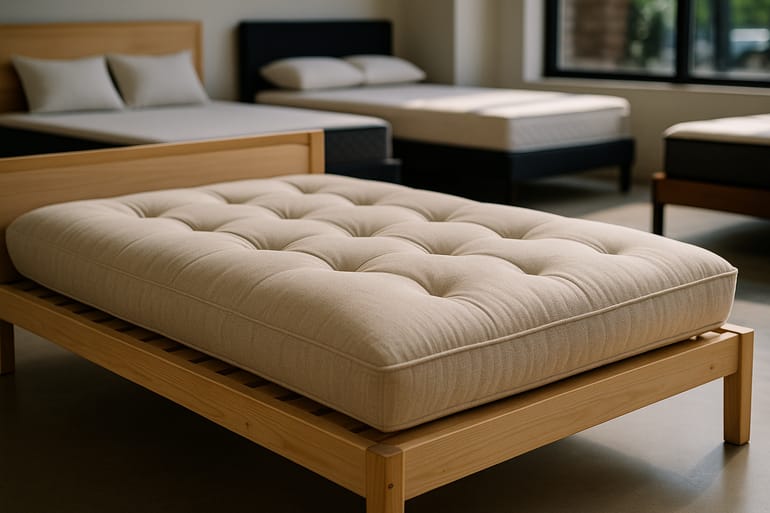
Firm futon mattresses shine when you want stable support without excess sink. If you’re choosing firm futon mattresses for yourself or advising customers, start with sleep position and frame type. A futon’s thinner profile and convertible design amplify how firmness, materials, and layering feel in real use.
What “firm” means on a futon
Most retailers describe firmness on a 1–10 scale. On futons, a true firm lands around 7.5–9/10, depending on core density and cover quilt. A latex-core futon feels more responsive than foam or cotton-only builds, so a “firm” latex can still ease pressure without sag.
Key takeaways
- Back sleepers need neutral spinal alignment with light contouring.
- Side sleepers need pressure relief at shoulders/hips, even on a firm build.
- Stomach sleepers need maximum lift to prevent lower-back sway.
For small spaces, firm futon mattresses also keep seating comfort crisp when the frame is upright. On bi‑fold or tri‑fold frames, a supportive core resists bunching at the hinge and returns to shape quickly. If you sell to mixed-use households, recommend a firm core with a thin, softer topper for guests—this combination preserves seat feel while tailoring sleep comfort.
Back, side, or stomach: matching firmness to sleepers

Back sleepers (best: medium‑firm to firm)
Aim for 7.5–8/10 on firm futon mattresses. A dense latex core with light quilting supports the lumbar while allowing minimal give at the shoulders. Consider zoned slats or a frame with tight spacing for extra mid‑section lift.
Side sleepers (best: firm core + plush top)
Side sleepers can still enjoy firm futon mattresses if you pair a firm core with a slightly softer surface. Try a Talalay latex comfort sheet over a Dunlop core or add a thin wool/cotton pad. Target 7–7.5/10 so shoulders can nest without bottoming out.
Stomach sleepers (best: firmest feel)
Go 8–9/10. You want strong anterior support to prevent the hips from dipping. Choose higher-density Dunlop latex or firm foam with minimal quilting. Keep profiles slimmer to reduce hammock effect on convertible frames.
Quick fit checklist
- Spine stays straight in a casual side view.
- No pressure hot spots after 10–15 minutes.
- You can change positions without effort (good responsiveness).
- On the sofa setting, seat feels supportive, not board‑stiff.
When advising shoppers, ask primary position first, then weight and frame style. Heavier sleepers generally benefit from one half‑step firmer within the same construction.
Inside a firm futon: materials, layers, and latex types
Core options that feel truly firm
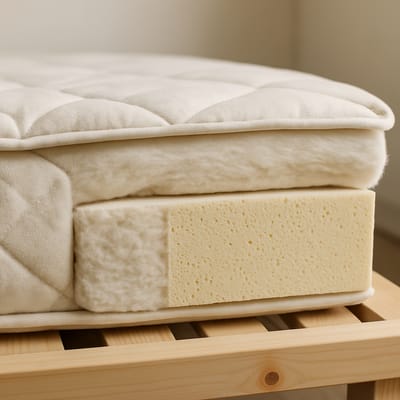
- Dunlop latex: Dense, stable, and highly durable—ideal for firm futon mattresses where support is the priority.
- Talalay latex: Airier feel with a touch more surface plush; great as a comfort layer over a firm core.
- High‑density foam: Budget‑friendly firmness; check for strong edge support and minimal compression set.
- Hybrid futon (latex + cotton/wool): Natural hand-feel with moisture management and steady lift.
Layering that works
A reliable build for firm futon mattresses uses a thick Dunlop core, a thin Talalay comfort sheet (optional), then compact quilted cotton/wool. This pairing keeps the surface engaged for seating while delivering sleep support.
Frame and slats matter
- Slat spacing: target ≤ 2.5–3 in (6–7.5 cm) to avoid soft spots.
- Bi‑fold vs tri‑fold: firmer cores resist hinge bunching and recover faster.
- Ventilation: latex breathes well; pair with a breathable cover to reduce heat.
Natural latex also extends longevity—the resilience resists body impressions better than cotton‑only futons. For retailers, highlight the feel difference: Dunlop = firmer base; Talalay = gentler surface without sacrificing support.
How to test firmness in-store (and at home)

A simple, repeatable evaluation protocol
- Alignment snapshot: Have the shopper lie in their primary position. From the side, check that ear–shoulder–hip forms a near‑straight line.
- Pressure scan: Ask for a 2‑minute hold on shoulders and hips (side) or hips and ribs (stomach). Hot spots mean the surface is too hard; sag means not firm enough.
- Roll test: They should roll without “stuck” feeling—good responsiveness is key on firm futon mattresses.
- Seat check: Convert the frame to sofa mode. The seat should feel supportive for 10 minutes without numbness.
- Frame audit: Confirm slat spacing and hinge action match the mattress build.
At-home validation
- Use a thin topper to fine‑tune pressure without losing core firmness.
- Recheck alignment after 7 nights; bodies acclimate, but pain should decline.
- If hips drop, try a firmer base board or add slats to tighten spacing.
Provide a one‑page guide with these steps; it boosts confidence and reduces returns while making firm futon mattresses easier to recommend.
Care, longevity, and small-space performance tips
Make firmness last longer
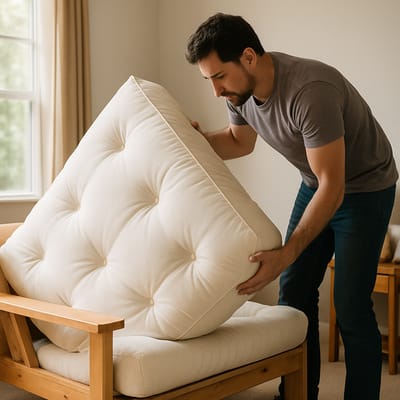
- Rotate and flip monthly for the first 3 months, then quarterly.
- Use a breathable protector; latex and wool regulate moisture best.
- Keep slat gaps ≤ 3 in to maintain even support and avoid soft zones.
Small-space advantages
Firm futon mattresses keep a clear seating profile in sofa mode and transition cleanly to sleep mode. A dense Dunlop core resists body impressions, so the mattress looks tidy in living areas. For tri‑fold frames, choose thinner profiles to limit hinge stress and improve fold geometry.
Expected lifespan
Latex‑rich builds often outlast cotton‑only futons, maintaining support and shape for years. Teach customers the “quarter test”: if you can slide a coin under the lower back when lying supine, support is intact; if the hip area sags visibly, it’s time to rotate or consider a firmer base.
For retailers, document frame specs on the tag (slats, hinge type, weight limit). Clear guidance reduces service calls and helps customers keep their firm futon mattresses performing like day one.