Double vs Queen: Small Room Size Guide (UK) 2026

Breadcrumb
Home > mattresses > mattress Sizes > double
Double vs queen in small rooms: what changes?
Choosing between a UK double and a UK queen looks simple until you try to live with it in a small room. For most UK shoppers, the double is the familiar 135x190 cm option, while queen typically means a larger footprint (most often 150x200 cm in UK listings, though sizing can vary by retailer). That extra width and length can turn an “it fits” plan into daily frustration: clipped walkways, drawers that don’t open, or a wardrobe you have to sidestep.
Start with the reality check: in a small bedroom, your comfort depends as much on clearance space as on mattress size. A double can feel plenty generous for one sleeper and workable for two, especially when you prioritise circulation space and storage access. A queen can feel like a hotel upgrade, but only if the room still allows you to move naturally around the bed.
If you want the UK specifics on doubles first (including regional naming quirks), double mattress sizing guide: 135x190 cm and regional UK variations lays out the baseline dimensions you should plan around before you compare upgrades.
Quick rule: if you’re already compromising on walkways with a double, a queen rarely “works out” in the long run.
UK double (135x190) vs UK queen: size and space impact

A mattress size decision is really a room-planning decision. Here’s what typically matters in UK homes:
Typical UK dimensions to know
- UK double: 135 x 190 cm (standard reference size)
- UK queen (common retail size): about 150 x 200 cm
That means a queen is usually around +15 cm wider and +10 cm longer than a double. Those numbers sound small, but they can be the difference between:
- opening bedside drawers without turning sideways
- having space for a narrow bedside table on both sides
- not banging your shins on a bed corner in a tight layout
The clearances that make a room feel “livable”
Aim for these practical targets where possible:
- 60 cm minimum for a main walkway (more feels noticeably better)
- 45–60 cm to access wardrobes and drawers comfortably
- enough space to open doors fully without hitting the bed or your knees
Interior/design enthusiasts often focus on symmetry (two bedside tables, centred headboard wall). In smaller rooms, you may need to prioritise function over perfect symmetry: one bedside table, wall-mounted lights, or sliding-door wardrobes.
If you’re unsure what “double” means in the UK versus other labels you see online, the sizing nuances in double mattress sizing guide: 135x190 cm and regional UK variations help you avoid ordering a size that doesn’t match the product listing or your frame.
How do you measure a small bedroom for double or queen?
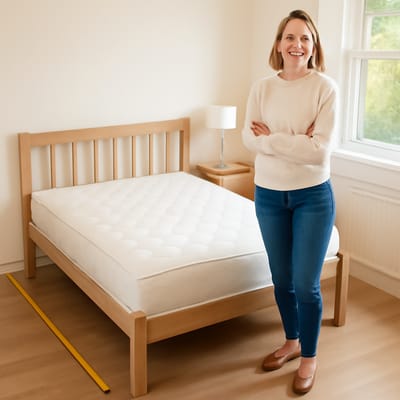
Measure before you fall in love with a bigger size. Small-space homeowners especially benefit from treating this like a mini layout project.
Step-by-step measuring that actually prevents mistakes
- Measure the room’s usable footprint, not just wall-to-wall. Radiators, bay windows, and built-ins reduce real space.
- Mark the bed footprint on the floor using masking tape (135x190 for a double; use the queen size you’re considering from the listing).
- Test your clearances: walk the taped routes to the wardrobe, window, and door. Mimic real movements like pulling out drawers.
- Check door swings and drawer runs. A bed can “fit” but still block a wardrobe door from opening.
- Confirm your bed frame internal size. Frames vary, and some have chunky headboards/footboards that steal clearance.
For the frame side of the equation, how to measure your bed frame for a double mattress walks you through the exact points to measure so you don’t end up with gaps, overhang, or a mattress that won’t sit correctly.
A small-room layout tip that saves space
If you’re choosing between double vs queen for a compact room, consider whether you can place the bed with one side against a wall. It’s not everyone’s preference, but it can preserve a usable walkway and make a queen possible in a room where a centred layout would fail.
Practical check: if taped clearances force you into shuffling sideways, stick with a double and improve comfort via mattress quality rather than size.
Which feels better: upgrade to queen, or buy a better double?
Because you’re balancing comfort and space, the smartest “upgrade” isn’t always a bigger mattress. Often, a high-quality double outperforms a cramped queen in day-to-day happiness.
Choose a double when…
- you need reliable walkways in a small bedroom
- you use under-bed storage or drawers and need access
- you want a room that feels open (important for design-focused layouts)
- you’re furnishing a guest room, rental, or first home where flexibility matters
Choose a queen when…
- you can keep functional clearance on at least the main access side
- you’re taller (the extra length can matter)
- you share the bed nightly and both sleepers want more elbow room
Product guidance without brand pressure
Non-brand mattress buyers typically get the best value by focusing on specs rather than logos:
- support core: pocket springs or high-density foam
- comfort layer thickness: enough cushioning for your sleep position
- edge support: crucial if you’re sharing a double
- trial/returns: helpful when you can’t test in-store
If you’re torn, a good approach is: keep the double size (135x190) for the room, then improve comfort with a better build and a firmness that suits your body. Many shoppers also compare price thresholds (for example, “under £300”) to find value; that topic deserves its own deep dive alongside materials like memory foam versus hybrids.
Decision shortcut: if upgrading to queen forces you to remove bedside storage or blocks a wardrobe, spend that budget on a better double instead.
A quick checklist to decide double vs queen (small rooms)
Use this simple checklist to reach a confident decision in 10 minutes.
1) Confirm the exact sizes you’re comparing
- Double should be 135x190 cm in UK listings.
- Queen varies, so verify the product page dimensions before planning.
2) Map your “must-do” movements
- getting dressed (wardrobe access)
- making the bed
- opening drawers (dresser or under-bed)
- moving laundry baskets or a vacuum around the bed
3) Minimum clearance targets
- Try for 60 cm along the main walkway.
- Ensure doors and drawers open without contact.
4) Pick the layout that fits your style goals
Design enthusiasts often want a centred bed and balanced bedside lighting. If the room is tight, consider wall-mounted sconces, floating shelves, or a single larger bedside surface instead of two tables.
5) Decide with your “non-negotiable”
- If your non-negotiable is space and access, choose a double.
- If your non-negotiable is sleeping space for two, consider queen only if clearances still work.
Once you’ve chosen the size, you’ll be in a much stronger position to compare build types and prices without second-guessing the footprint. When you need a refresher on the double baseline and UK naming variations, double mattress sizing guide: 135x190 cm and regional UK variations is the reference point that keeps planning consistent.
Bottom line: in small rooms, the “right” size is the one that lets you live normally, not just sleep.
FAQ: Double vs Queen for small rooms in the UK
Is a UK double always 135x190 cm?
In most UK retailers, double refers to 135x190 cm. Some listings may use different naming or include the frame size, so always confirm dimensions on the product page.
What size is a queen mattress in the UK?
UK “queen” commonly refers to a larger mattress than a double, often around 150x200 cm, but it can vary by retailer. Always check the stated measurements before you plan your room layout.
What’s the minimum room size for a double vs queen?
There’s no single minimum because furniture, doors, and storage change the usable space. As a practical guide, plan for about 60 cm of main walkway clearance; if a queen removes that, a double is usually the better fit.
How can I make a double look more ‘designer’ in a small bedroom?
Focus on proportion: use a slimmer frame, wall-mounted lights, and one larger bedside surface if two won’t fit. A centred rug and cohesive bedding can make a double feel intentional rather than “small.”
I’m a small-space homeowner—should I prioritise storage over a bigger bed?
If losing storage means clutter builds up, the room will feel tighter even with a larger mattress. A double often leaves more room for drawers, wardrobes, or under-bed storage while still being comfortable.
Do I need a different bed frame for a queen?
Usually, yes. Mattress sizes require matching frames, and even small differences can cause overhang or gaps. Measure your current frame carefully before switching sizes.
Are non-brand mattresses risky compared to big-name options?
Not necessarily. Look for clear specs (materials, density, spring count type), a solid returns policy, and a sleep trial if possible. Those factors matter more than a label when you’re buying online.
What’s the biggest mistake people make when choosing double vs queen?
They check if the bed fits, but not if the room still functions. Taping the footprint and testing door swings and drawer access prevents most regret purchases.